Spontaneous Glass Breakage: Why Tempered Glass Shatters on Its Own (and How to Prevent It)
If you’ve ever heard a sharp crack from a window or shower door for no apparent reason, no impact, no temperature shift, no warning, you’ve likely witnessed spontaneous glass breakage. It’s one of the most misunderstood failure modes in the glazing industry, and one of the few that can occur years after installation with zero outward signs of trouble.
This guide explains what causes spontaneous breakage of glass, how to identify it after the fact, and most importantly the specifications and processes that prevent it from happening on your project. It’s written for architects, building owners, project managers, and glaziers who need to make decisions about glass selection, specification, and risk management.
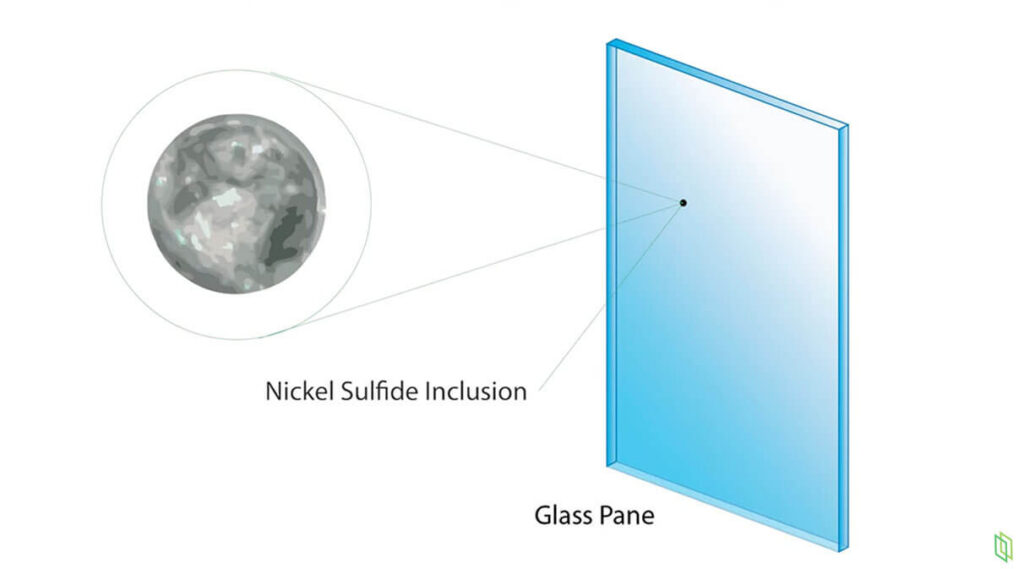
The short answer: Spontaneous glass breakage almost always refers to tempered glass that fractures without external cause, usually because of a microscopic nickel sulfide (NiS) inclusion trapped inside the glass during manufacturing. The inclusion slowly changes volume over time and eventually generates enough internal stress to shatter the lite. The industry-standard prevention is a heat soak test (per EN 14179), which forces unstable inclusions to fail in the factory rather than in the building.
What Is Spontaneous Glass Breakage?
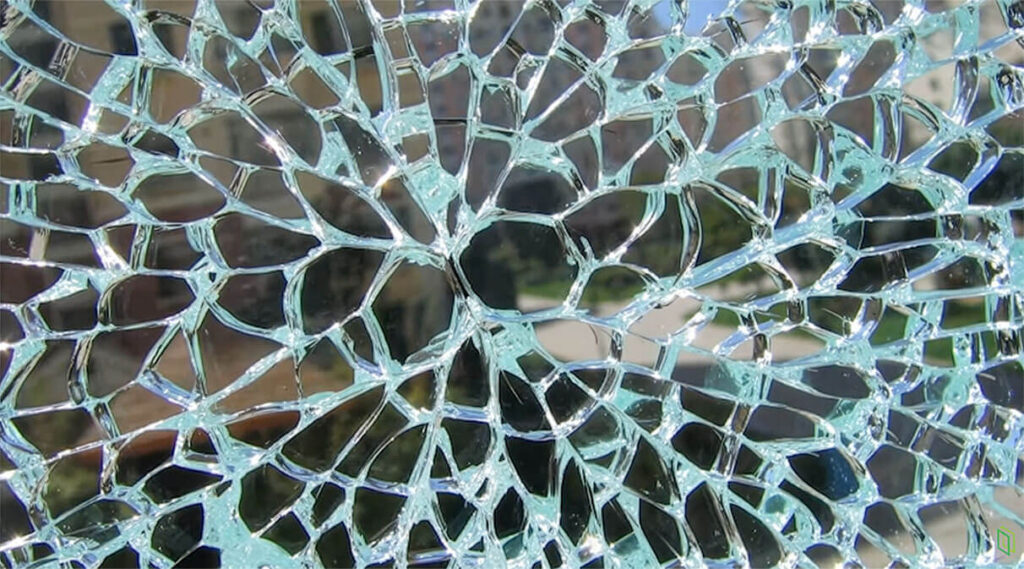
Spontaneous breakage, sometimes called “self-detonation” in the industry, is the unprompted shattering of fully tempered glass without any identifiable external trigger. The lite simply explodes into the small, granular fragments characteristic of tempered glass, often falling from the frame in a single sheet of webbing if the glass is laminated.
It is rare, but it is real. Most credible industry estimates put the rate at roughly 1 to 8 fractures per 10,000 lites of tempered glass installed, depending on the manufacturer’s quality controls and whether heat soaking was performed. On a single 200-lite curtain wall, that means a non-trivial probability of at least one event over the building’s service life.
Spontaneous breakage does not occur in:
- Annealed glass: it has no stored compressive stress to release.
- Heat-strengthened glass: the compressive surface stress is roughly half that of tempered, which is generally insufficient to drive NiS-related failure.
- Laminated glass: it can still break, but the interlayer holds the fragments in place, often making the failure non-catastrophic.
This is why understanding the difference between tempered and heat-strengthened glass matters so much in specification, the choice has direct implications for spontaneous breakage risk.

What Causes Tempered Glass to Break by Itself?
1. Nickel Sulfide (NiS) Inclusions: The Primary Cause
During the float glass manufacturing process, microscopic particles of nickel sulfide can form when trace nickel contaminants (from refractory materials, stainless steel scrap, or process equipment) combine with sulfur in the molten batch. These inclusions are typically 50 to 500 microns in diameter, invisible to the naked eye and undetectable by standard quality inspection.
Nickel sulfide has two crystalline phases:
- Alpha phase: the stable form at high temperatures (above ~380°C).
- Beta phase: the stable form at room temperature, roughly 4% larger by volume than alpha.
When float glass is tempered, it’s heated above 600°C and then rapidly quenched. The rapid cooling “freezes” any NiS inclusions in the high-temperature alpha phase. Once the glass is in service, the inclusion slowly transitions back to its larger beta form. That expansion happens inside the tensile core of the tempered glass, exactly where the glass is least able to resist additional stress and eventually the inclusion grows enough to initiate a fracture.
The transition can take days, months, or decades. Most NiS-related failures happen within the first five to seven years of installation, with peak failure rates in years two through four.
2. Thermal Stress and Edge Damage (Often Misdiagnosed as Spontaneous)
Not every unexplained break is a true NiS event. Two other failure modes are commonly mistaken for spontaneous breakage:
- Thermal stress fracture: A temperature differential of more than ~40°C between the center and edge of a lite caused by shading patterns, applied films, interior heat sources, or improper edge insulation can drive a crack from the edge inward. Cracks from thermal stress are typically perpendicular to the edge and start at an edge defect.
- Edge damage propagation: Tempered glass is strong in the face but fragile at the edge. A small chip or shell from rough handling during fabrication or installation can act as a stress concentrator. Under load wind, thermal, or even just deflection over time, the flaw can propagate without an obvious trigger.
Forensic identification of the failure mode matters because it determines liability and the appropriate fix. The fracture origin and pattern usually reveal the cause.
Identifying the Cause from the Fracture Pattern
If a lite breaks unexpectedly, the broken glass itself usually tells you what happened. Capturing the fragmentation pattern, photographing the failed lite before cleanup, and ideally preserving fragments from the suspected origin, is essential for any insurance claim or warranty discussion.
| Failure Type | Visible Pattern | Root Cause |
| Spontaneous breakage (NiS) | Characteristic “butterfly” or figure-8 pattern centered on the inclusion | Nickel sulfide inclusion expanding inside tempered glass over months or years |
| Thermal stress fracture | Crack originates at the edge, perpendicular to the edge | Temperature differential across the lite, often near edge seal or framing |
| Impact breakage | Radiating cracks from a single point of impact | External force: debris, hardware contact, vandalism |
| Edge damage failure | Origin at a chip, nick, or shell along the edge | Fabrication, handling, or installation damage that propagates under load |
The classic “butterfly” or figure-8 pattern is the signature of a true NiS failure. Two roughly triangular fragments sit on either side of the inclusion, which is often visible as a small black or amber dot at the center of the pattern when examined under magnification.
How to Prevent Spontaneous Glass Breakage
Spontaneous breakage cannot be eliminated entirely, but the risk can be reduced by an order of magnitude with the right specification choices. There are four practical levers, from most to least effective:
1. Specify Heat-Soaked Tempered Glass
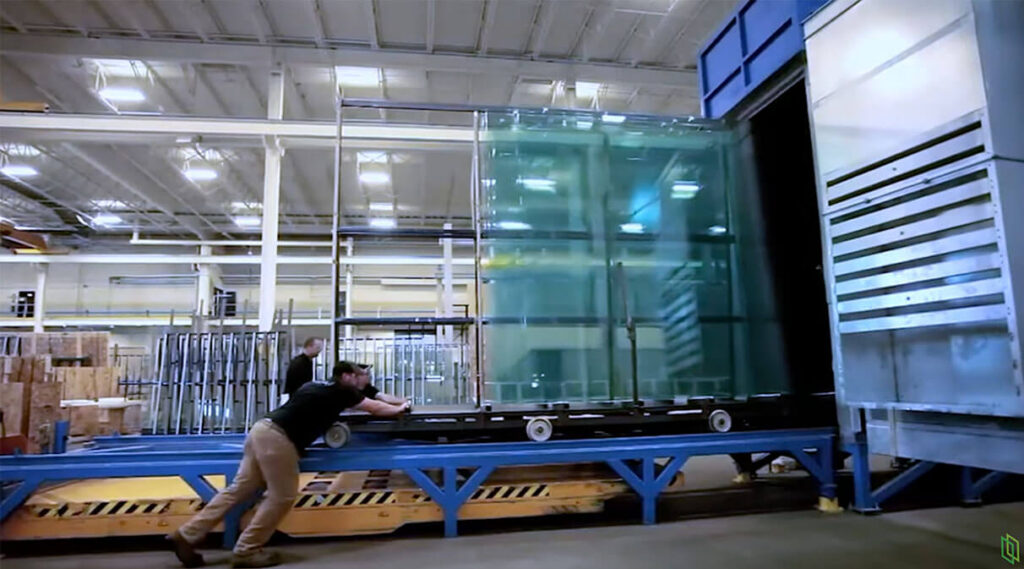
Heat soak testing (HST) is the most direct prevention method. After tempering, the glass is placed in a chamber and held at 290°C for at least two hours. This accelerates the alpha-to-beta phase transition: lites containing unstable NiS inclusions will fail in the chamber rather than on the building.
The European standard EN 14179-1 is the global benchmark. After a proper heat soak per this standard, the residual failure rate drops to roughly 1 in 400 tons of glass, a reduction of roughly 95% compared to non-soaked tempered glass.
In the United States, heat soaking is not required by ASTM standards but is widely available as a fabricator option. Specify it explicitly in your tempered glass schedule for any of these high-risk applications:
- Overhead glazing (skylights, canopies, sloped curtain walls).
- Frameless balustrades and railings.
- Tall buildings where falling glass poses a public-safety risk.
- Shower enclosures and other enclosed spaces where occupants are in close contact with the glass.
- Any installation where post-installation replacement is costly or disruptive.
2. Use Heat-Strengthened Glass Where Code Allows
If safety glazing is not required by code, heat-strengthened glass eliminates the NiS risk almost entirely. The lower surface compression (3,500–7,500 psi versus 10,000+ psi for tempered) is generally insufficient to drive NiS-related failure. Heat-strengthened glass is the right call for most monolithic exterior applications where impact safety isn’t the controlling load.
3. Laminate the Tempered Glass
Laminating tempered glass with a PVB or SGP interlayer doesn’t prevent breakage, but it does change the consequences. When a laminated lite fails, the fragments stay bonded to the interlayer rather than falling. For overhead glazing and any application where falling glass is the primary risk, laminated heat-strengthened glass (rather than monolithic tempered) is usually the better engineering choice.
4. Source from Quality Fabricators
Not all tempered glass is created equal. Reputable float glass producers, the small handful of global manufacturers, maintain tighter contamination controls and lower NiS inclusion rates than secondary or import-grade sources. Ask for the float glass origin and the heat soak certification when specifying for high-risk applications.
What to Do If You Suspect Spontaneous Breakage
- Document everything before cleanup. Photograph the failed lite in place, the fragmentation pattern, and the surrounding installation. Note the date, temperature, and any recent activity in the area.
- Preserve fragments from the suspected origin. If the lite has fallen, recover the fragments closest to the apparent fracture origin. A forensic glass lab can identify NiS inclusions under microscopy.
- Check the heat soak certification. If the glass was specified as HST per EN 14179, the failure may indicate a process deviation, grounds for warranty action against the fabricator.
- Audit similar lites in the same installation. NiS inclusions are random, but they correlate with batch. If one lite in a curtain wall failed from NiS, the rest of the same production lot has elevated risk. A polariscope inspection can identify high-stress areas in the remaining lites.
- Reassess specification for any replacement glass. If the building has overhead or balustrade glazing without heat soaking or lamination, the replacement is an opportunity to upgrade the spec across the assembly.
Yes, though there is always a reason, even when it isn’t visible. The most common cause is a nickel sulfide inclusion that’s been quietly expanding inside the glass since manufacturing. The break appears spontaneous because nothing external triggered it, but the failure mechanism has been in progress for years.
Most NiS-related failures happen within five to seven years of installation, with peak rates in years two through four. Failures more than a decade out are rare but documented.
No. A properly performed heat soak per EN 14179 reduces the failure rate by approximately 95%, not 100%. Some inclusions are stable enough to survive the soak temperature but still transition over the much longer service life of the glass. Heat soaking is the best available prevention, but it isn’t absolute.
It depends on the manufacturer’s and fabricator’s warranty terms. Many tempered glass warranties explicitly exclude NiS-related failure unless the glass was specified and certified as heat soaked. Reviewing the warranty language before specification — not after a failure, is the practical move.
Look at the fracture origin. NiS failures have a characteristic butterfly pattern with two roughly triangular fragments meeting at a central point, often with a visible inclusion (a dark speck under magnification). Thermal stress and edge damage failures originate at the perimeter and propagate inward. When in doubt, a glass forensics lab can confirm with microscopic analysis.
Most residential tempered glass installations carry low absolute risk, but the consequences of failure in a shower or on a railing are high. If you’re specifying new installations, ask for heat-soaked tempered glass, or specify laminated tempered glass for applications where falling fragments would be a concern.
Specifying Glass Without the Surprises
Spontaneous breakage is one of the few glass failure modes that’s genuinely unpredictable at the lite level, but it’s entirely predictable at the project level. Specify heat-soaked tempered glass for high-risk applications, use heat-strengthened glass where code allows, laminate where falling glass is a concern, and source from fabricators who can document their process. The risk doesn’t go to zero, but it goes from a real engineering concern to a vanishingly rare event.
If you’re working through a glazing specification and want a deeper walk-through of the relevant standards, fabrication processes, and decision frameworks, the courses at LearnGlazing cover this material in working-glazier detail.