

LearnGlazing Launches Advanced Course on Glazing Systems Interaction Details
FOR IMMEDIATE RELEASE
New free course shows glazing contractors, project managers, and drafters how storefront and curtain wall systems tie into the building envelope, and where those connections fail

SOUTH LYON, Mich., September 8, 2026: LearnGlazing, the online education platform built for the commercial glazing industry, today announced the release of its newest course, Glazing Systems Interaction Details. The free course is available now at LearnGlazing.com and joins a growing library of more than 40 courses created to help glazing companies train new hires, support field teams, and standardize knowledge across their operations.
Storefront and curtain wall systems are engineered, tested, and proven to perform. Most glazing failures do not come from the system itself. They start at the interfaces, the places where the glazing frame meets structure, air and water barriers, sealants, flashings, and adjacent wall systems, and where several trades have to coordinate. Those failures often stay hidden until the building is exposed to weather, by which point barriers are concealed, finishes are installed, and repairs are costly and disruptive.

Glazing Systems Interaction Details treats those interfaces as performance-critical design conditions rather than secondary details. Built around annotated shop drawing style CAD details, color-coded trade responsibility diagrams, and photographs of real installed failures, the course walks learners through:
- Advanced detailing and the shop drawing phase, including how to use shop drawings and RFIs to resolve barrier terminations, sealant responsibility, and sequencing on paper instead of in the field
- Designing for dimensional tolerances, so perimeter joints, slotted anchors, and oversized pockets have room to absorb out-of-square openings and accumulated framing tolerances
- What a membrane tie-in actually has to do, why glazing the membrane directly into the glazing pocket is often a poor strategy, and how to check sealant continuity around the entire opening at the head, sill, and jamb together
- Aligning barriers with the system’s primary seal and drainage strategy, so water is directed to the wet zone and out of the building rather than past the control point
- Sealant geometry, joint sizing, backer rod depth, substrate compatibility, and the difference between adhesive and cohesive failure
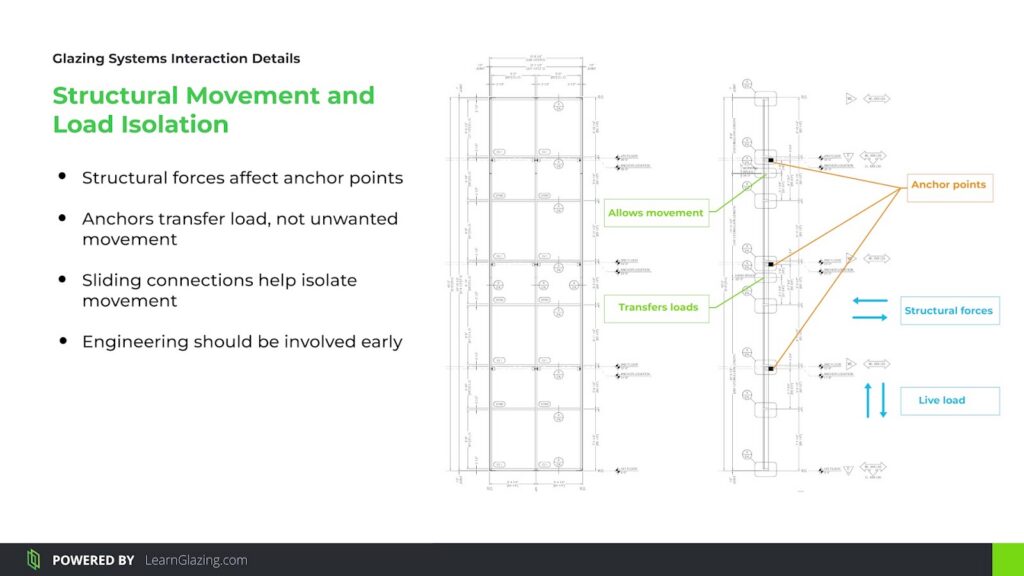
- Thermal expansion, structural movement, and load isolation, including a working rule of thumb for aluminum expansion, why a half-inch nominal joint can become inadequate quickly, and why anchors must transfer load without transferring movement into the frame
- Head, sill, and jamb conditions taken one at a time: movement first at the head, water management and clear weep paths at the sill, and continuity across systems and trades at the jamb
- Galvanic corrosion and metal isolation where aluminum meets steel embeds, anchors, and fasteners
- Field adhesion testing, mock-ups, and designing sealant joints that can be inspected and replaced over the life of the building
By the end of the course, learners can identify high-risk interfaces during design and shop drawing review, ask the right questions of the architect, waterproofer, manufacturer, and engineer before installation, and verify in the field that joint sizes, movement clearances, and tie-in locations match the intent.
LearnGlazing.com is approved by the North American Contractor Certification (NACC) and the Architectural Glass and Metal Technician (AGMT) certification program for continuing education within their certification programs. Glazing Systems Interaction Details is also registered for American Institute of Architects (AIA) continuing education, earning qualified members 1 LU/HSW credit upon completion.
“Almost every leak call we hear about traces back to a head, sill, or jamb where two trades each did their part correctly and nobody owned the joint between them,” said Chris Martin, Head of Sales and Marketing at LearnGlazing. “This course teaches people to think like integrators instead of installers. It shows a PM or drafter how to read a detail for barrier continuity, movement, and sealant compatibility, and how to get those questions answered while they are still cheap to fix.”
The course was made possible in part by the generous support of Tubelite, whose support helps keep free glazing education available to the industry. Tubelite storefront and curtain wall systems appear throughout the course as real-world system examples.
Glazing Systems Interaction Details is free and available now at learn.learnglazing.com/courses/glazing-systems-interaction-details. Glazing companies interested in team training and workforce development resources can learn more at LearnGlazing.com.
About LearnGlazing
LearnGlazing provides practical online training built by commercial glazing professionals for commercial glazing professionals. Its course library covers storefront, curtain wall, doors and hardware, glass products, shop drawings, and project management, helping companies onboard new hires faster, reduce the training burden on senior field staff, and prepare the next generation of glaziers. LearnGlazing is part of the GlazierIQ family of brands, which also includes MP Drafting and WestMetal Fabrication.
Media Contact:
Chris Martin
Head of Sales and Marketing, LearnGlazing
chrism@learnglazing.com
(248) 733-5906
###